· intuitem · News · 4 min read
Meet Paul: an open LLM for EBIOS Risk Manager that runs on your laptop
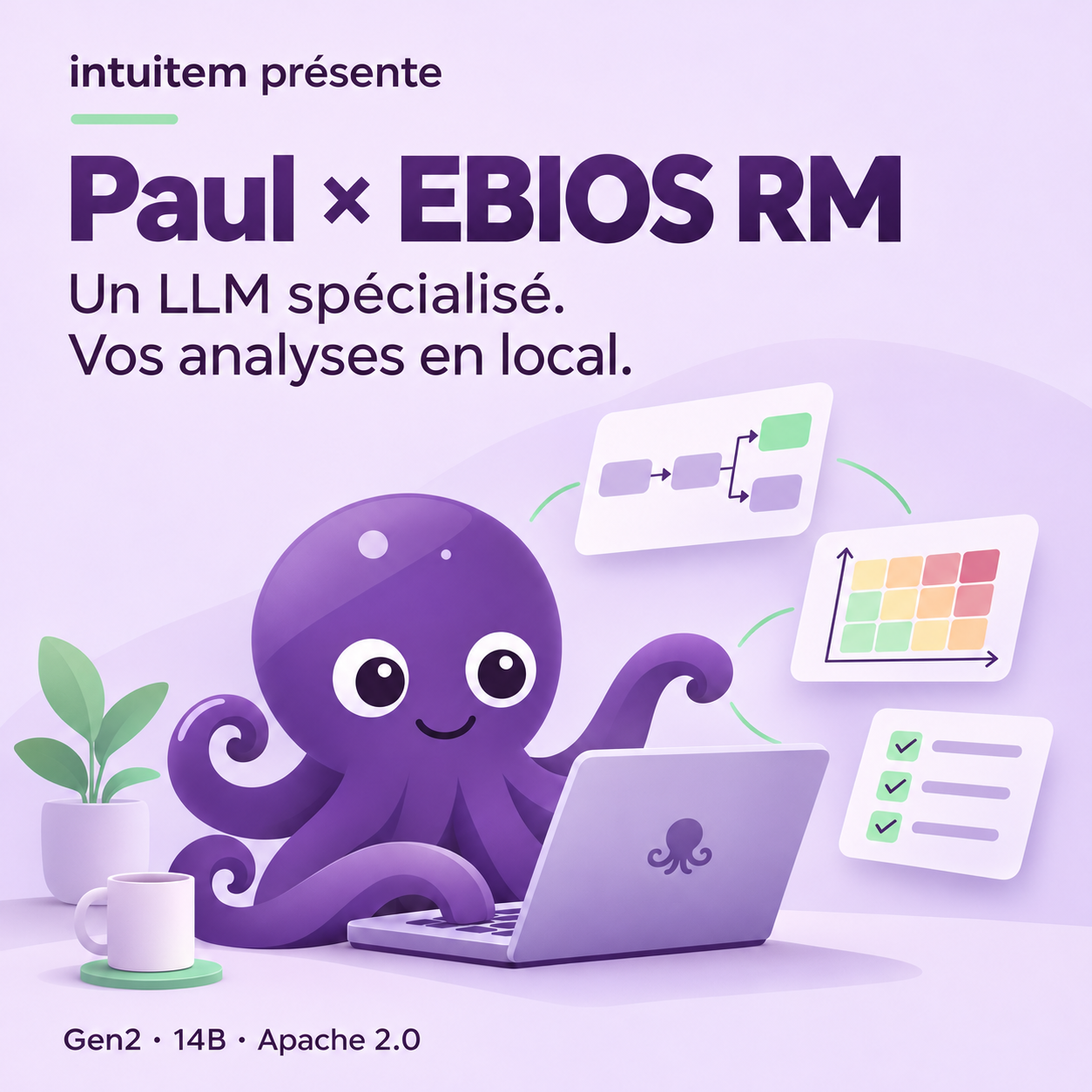
Paul is a 14B language model specialised in governance, risk and compliance, trained on EBIOS Risk Manager and built to run locally. The second generation is out on Hugging Face under Apache 2.0, in French and English.
A risk analysis describes your critical assets, your weaknesses and the scenarios that threaten your organisation. That is exactly the kind of information you can’t always send to a remote service.
We built Paul for that situation: a language model specialised in governance, risk and compliance (GRC), trained on EBIOS Risk Manager, that runs on your own hardware. Today we are publishing its second generation on Hugging Face. Paul answers in French and English, its weights are released under the Apache 2.0 licence, and every source document it was trained on is listed publicly.
Why a specialised model?
In our tests, general-purpose models mixed up the EBIOS RM workshops, invented steps or rating scales, and sometimes went along with false assumptions in the question.
On our set of 338 closed-book EBIOS RM questions (no access to the documents), the base model scored 0.12. Paul scores 0.44. For reference, Gemma 4 31B without any adaptation scored around 0.18 to 0.20 on the same set: Paul more than doubles that with less than half the parameters.
Paul is not trying to beat large cloud models on every topic. It targets one job, done locally, on hardware you can actually get.
What it can help with
- Understanding EBIOS RM: workshops, concepts, vocabulary, rating scales and deliverables.
- Moving a risk analysis forward, from the framing to the risk treatment plan.
- Spotting a wrong premise in a question and correcting it.
- Calling the tools an application provides and answering in JSON, for example CISO Assistant’s MCP tools.
Compared with the first generation (Poulpe Gen1), Paul follows long studies better, repeats itself less, and is better at telling true, false and partially true premises apart.
| Held-out set | Paul Gen2 | Poulpe Gen1 |
|---|---|---|
| Closed-book EBIOS RM questions (338) | 0.441 | 0.405 |
| True, false and partial premises (134) | 0.412 | 0.362 |
| Driving a study with terse replies (18 sessions) | 0.640 | 0.546 |
| Tool calling, CISO Assistant MCP tools (36) | 1.000 | 0.986 |
| Schema-validated JSON output (10) | 1.000 | 1.000 |
Scores run from 0 to 1. Knowledge sets are graded by an LLM judge against reference answers and the source pages (noise about ±0.02); tool calls and JSON are checked deterministically. The full evaluation is on the model card.
How it was built
Paul is based on Mistral AI’s Ministral 3 14B. We adapted it with about 60,000 examples generated from 89 documents: question-answer pairs, corrections of false premises, multi-turn workshop sessions, tool calls and general IT answers. The examples are reformulations, not copies of the documents.
The sources include ANSSI resources, used with ANSSI’s permission: the EBIOS RM guide v1.5, the method sheets, the training kit, the homologation, hygiene and mapping guides, and ReCyF. They also include Club EBIOS material, ENISA and NIST publications, and MITRE ATT&CK. Every document and its licence is listed on the model card.
Running it
The recommended Q4_K_M quantisation is about 8 GB. A 16 GB GPU or an Apple Silicon Mac with 16 GB of memory or more runs it. With Ollama:
ollama run hf.co/intuitem/Paul-Gen2-14B-GGUF:Q4_K_MIt also works with LM Studio (search for “Paul”), llama.cpp, MLX or vLLM, depending on the format you pick. Use a temperature around 0.2. Paul speaks the OpenAI chat API, so you can use it on its own, in your own applications, or as the AI engine of CISO Assistant.
Limits
Paul is a research project and it can be wrong. It may recall the exact wording of rating scales or the values of the guide’s worked examples imperfectly, and long studies driven with very short replies can still drift. It follows the 2024 version of the EBIOS RM guide. Check its answers against the ANSSI guide, or give it the relevant pages when precision matters. A risk analysis stays the responsibility of the people who carry it out.
Got a wrong answer? Open an issue in the CISO Assistant repository with the question, the answer you got and the answer you expected. Your reports shape the next generation.